
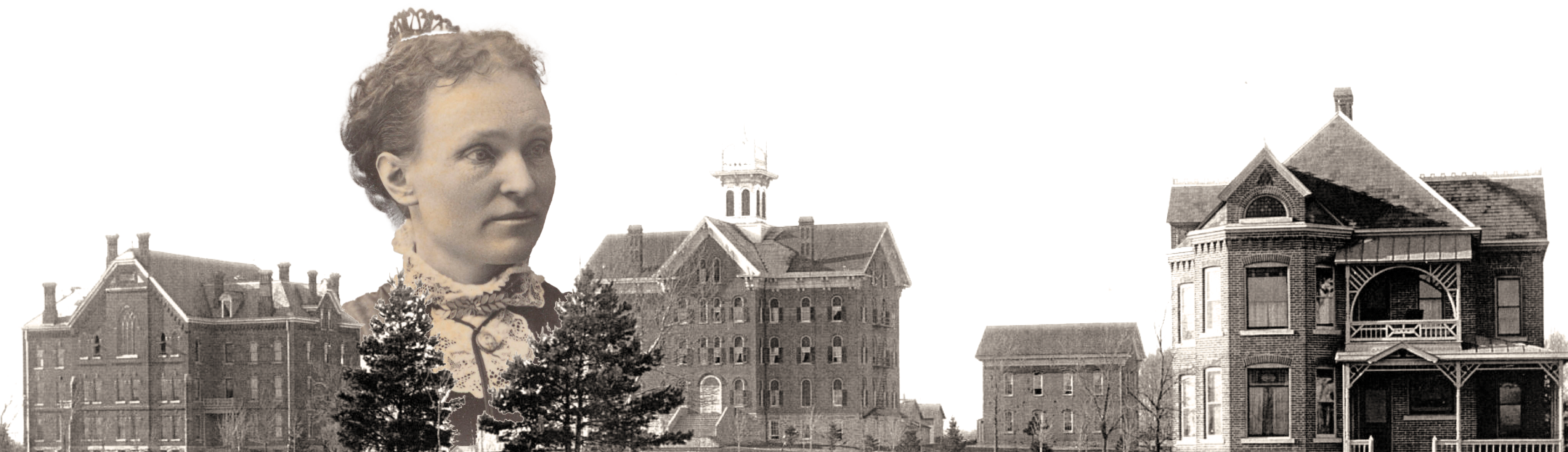
Laura Ensign: A pioneer who shaped UNI’s earliest years
Laura Ensign arrived in Cedar Falls in 1878, joining the Iowa State Normal School faculty at a moment when the institution was still defining what it would become. Her influence would help shape the academic culture that later grew into the University of Northern Iowa.
Ensign played a key role in defining how teachers were trained. Though her name is little known today, she emerged as one of the most influential faculty members in the school’s earliest decades and a central figure in its struggles over pay equity, academic freedom and professional recognition for women.

“She was everywhere in the records,” said Thomas Connors, professor of history and author of a study on Ensign’s career. Connors began researching Ensign after discovering her personal photo album for sale online, a chance find that led him to uncover a story largely forgotten.
Ensign was not the first woman to teach at the Normal School. Frances Webster, hired earlier, left after two years and never achieved the rank of professor. Ensign, however, would stay for 14 years and become a leader among her colleagues at a time when women’s authority in higher education was still contested.
Born in New York, Ensign came to Iowa with her family at age 5. She grew up in the first house built in New Hartford, which had been founded by her father and uncles. Education was a family value, and she pursued advanced study before entering teaching.
In 1879, she earned a master’s degree from the University of Iowa and was selected to deliver the commencement oration, becoming the first woman to do so. By the time she arrived in Cedar Falls, she was already recognized as a skilled educator with strong views about how teachers should be trained and had begun establishing herself as a specialist in history and geography pedagogy.
Those views soon put her at odds with the school’s leadership.
In the Normal School’s early years, Principal James Gilchrist assigned faculty to teach whatever subjects administrators thought necessary, regardless of their expertise and whether classes were available in their fields. Ensign objected. She believed instructors should teach in their areas of specialization, a position that placed her at the center of a broader fight for faculty governance and professional standards. With the support of her colleagues and the Board, she prevailed.
“She wanted teaching to be treated as a profession,” said Connors. “Not as interchangeable labor.”
Ensign also became a leading voice in disputes over salary and rank. At one point, the state Board of Directors reduced her pay after deciding all women faculty should earn the same salary, regardless of experience or responsibility. Ensign protested the policy, arguing that compensation should reflect work and qualifications, not gender. Others supported her, and the Board backed down from its controversial policy.
Her advocacy extended beyond herself. No woman at the Normal School held the rank of professor until 1889, when President Homer Seerley, an early advocate for women’s rights, pressed the Board to grant the title to women on the faculty and recognize women’s work as equal to men’s. Ensign was the first woman to be promoted, officially recognized as a professor in history and geography, marking a turning point for women across the institution.
The obstacles she faced were compounded by a difficult relationship with Principal James Cleland Gilchrist, the school’s first leader. Ensign had been hired over Gilchrist’s preferred candidate, a decision made directly by the board. The result was a strained and often hostile working environment that lasted for years.
Despite that tension, Ensign remained deeply invested in the school’s future. As Gilchrist’s position weakened, she quietly worked behind the scenes to recruit his successor, her friend and fellow educator Homer Seerley. When Seerley became principal in 1886, the institution entered a period of reform that aligned closely with Ensign’s long-held priorities.
“She was thinking institutionally, not just personally,” Connors said. “She wanted the school to be better for students and faculty alike.”
That commitment extended to her scholarship. Ensign authored textbooks on pedagogy and grammar that became widely used throughout the Midwest, including in Chicago. By 1900, her books sold more than 100,000 copies, a remarkable figure for the period, and helped standardize teacher training practices beyond Iowa. Her textbooks were still in print when she died in 1937.
Through her writing, Ensign reached classrooms she would never see in person. She advised teachers to “talk familiarly, do not lecture.” Her work emphasized clarity, structure and the intellectual seriousness of teaching, reinforcing the idea that education deserved the same respect as other professions.
Students, too, felt her influence. Ensign was known for high expectations and careful attention to instruction, traits that reflected her belief in preparation over simple memorization. She combined firm standards with steady support in the classroom. Her album is filled with pictures of early alumni that those students gave her.
Her career at the school ended in 1892, but the legacy of her efforts remained. The principles she championed — fair pay, academic specialization and professional rank — would become standard features of the institution as it evolved into a comprehensive university.
In that sense, Ensign’s story reflects the broader arc of the University of Northern Iowa’s history. The school’s early years were marked by experimentation and conflict, shaped by individuals willing to challenge existing norms. Ensign stands out among them not only because she was a woman in a male-dominated profession, but because she insisted that the institution live up to its educational mission. The arrival of Seerley began decades of rapid growth and academic modernization, and ended a decade when the survival of the school was uncertain.
Ensign’s life also underscores how easily such contributions can be forgotten. Unlike presidents or politicians, faculty pioneers often leave behind scattered traces rather than grand monuments. It took a chance discovery, a photo album offered for sale more than a century later, to restore Ensign to view.
As UNI observes its sesquicentennial, her story offers a reminder that progress is built through persistence as much as celebration. The ideals now associated with the university — academic excellence, commitment to students and respect for professional expertise — were once matters of debate.
Laura Ensign did not set out to make history. She set out to teach well, to be treated fairly and to see her profession taken seriously. In doing so, she helped lay the groundwork for generations of educators who followed, ensuring that the institution she served in its infancy could grow into the university it is today.
“Anyone who is familiar with the university in Cedar Falls will have recognized some names among Ensign’s colleagues,” Connors wrote at the conclusion of his booklet. “Buildings commemorate Gilchrist, Wright, Sabin and Seerley, who is also honored by a city park and boulevard.”
Laura Ensign is forgotten, as indeed are most of the women and men who taught on the Hill, yet she left a legacy, winning struggles over rank and pay for women and helping set the school on the path to faculty governance.”
In a career that ranged from rural schools in Butler County to elite girls’ schools of Minneapolis and Baltimore, her most significant contributions came during her time in Cedar Falls. A supportive family helped her navigate the seasons of her career, and it is in their plot near the front of the town cemetery a little north of New Hartford that a small gray headstone commemorating S. Laura Ensign can be found. While her family’s markers are labeled husband, wife, daughter, sister and aunt, Laura’s reads: “Teacher.”